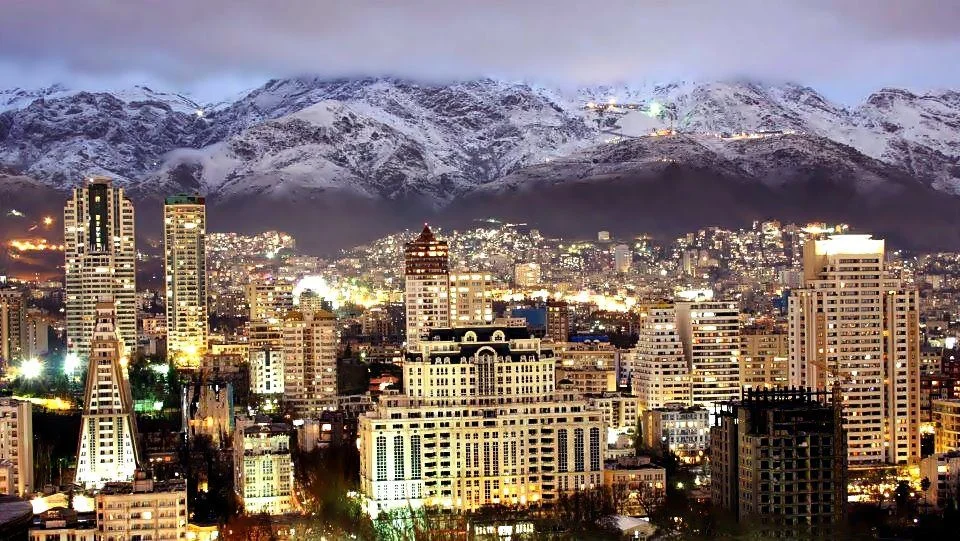
Tehran, with a population of 903,000, is the most populous city and also the capital of Iran. This city is one of the most important political, economic, and cultural centers in the Middle East. Tehran, a vibrant and ever-changing city, combines a historic past and a modern future. In this article, we intend to introduce the city of Tehran, stay with us.
With the discovery of a woman’s skeleton in the sewers of Molavi Street, it became clear that Tehran’s historical roots go back to pre-Islamic times (the Neolithic period).but Tehran’s remarkable growth dates back to the Qajar era, especially during the reign of Agha Mohammad Khan Qajar. At that time, Tehran was chosen as the capital of the country. Since then, it has witnessed extensive political, social, and economic developments. The capital of Iran changed several times during different periods, but in the end, Tehran was the most suitable option.
The capital of Iran
Geography and Climate
Tehran is located in the north of the country and on the southern slopes of the Alborz mountain range. Due to its geographical conditions, it has a diverse climate with very cold winters and hot summers.
This city has 22 urban areas and 122 districts, and also includes cities such as Tajrish and Rey. Notable neighborhoods include Darband, Zafaraniyeh and Farmanieh in the north; Hakimiyeh, Tehranpars and Narmak in the east; Punak, Janat Abad and Sattarkhan in the west; and Shush, Nazi Abad and Afsariyeh in the south.
The capital of Iran
Economy and Industry
Tehran is the main economic hub of Iran, with many large companies, factories, banks, and important government institutions located in the city. For example, Tehran’s Grand Bazaar is considered one of the most important commercial centers in the country. Half of the country’s economy is dedicated to Tehran. Tehran also receives many guests every year due to its many museums and palaces.
Culture and Arts
Tehran is considered the cultural capital of Iran. Galleries, theaters, museums, cinemas, and various art festivals are held in this city. Golestan Palace Museum, Niavaran Palace, Milad Tower, etc. are the important cultural and tourist centers of Tehran. Some major cultural and tourist attractions include:
1. Azadi tower
Azadi tower (Symbol of freedom) with its architecture blends Achaemenid, Sassanid, and Islamic styles was built to commemorate the 2500th anniversary of the Iranian Empire. The Kasra-shaped arch, traditional Yazdi windcatchers, and tile work all come together to create this unique architecture.
2. Milad Tower
This tower is 435 meters high and is one of the modern symbols of Tehran. This tower was completed in 2006 and the sixth tallest freestanding tower in the world.
3. Tabiat (Nature ) Bridge
Another modern architecture in Tehran is the “Nature Bridge”. This bridge is 270 meters long and it is the largest pedestrian bridge in Tehran. The bridge won the Aga Khan Award for Architecture in 2016.
4. Niavaran Palace Museum
It is a historical monument belonging to the Qajar era. This palace covers an area of 11 hectares and was built on two floors with a height of 14 meters. The architecture of this palace is very artistic.
5. Sa’dabad Palace
A large complex in the north of Tehran with several palaces, such as White and Green Palaces, which were the residences of the Pahlavi family.
6. Bam-e Tehran
A wonderful view of Tehran and a perfect place for hiking and mountain climbing.
7. National Museum of Iran
This museum has very valuable ancient and historical artifacts from all over Iran.
8. Darband
A mountainous and scenic area with traditional restaurants along the river.
9. Tehran Museum of Contemporary Art
It includes works by artists such as Dali, Picasso, and also many Iranian artists.
These are just some of the beauties of Tehran.
The capital of Iran
Amazing statistics from Tehran
1.Valiasr Street in Tehran with a length of about 17 kilometers, it is one of the longest streets in the world and the middle east. This street runs from the south of the city to the north of the city.
2. Tehran’s Metro system is among the largest in the Middle East.
3. Azadi Stadium is the largest stadium in the Middle East with a capacity of more than 100,000 spectators.
4.Tehran’s Grand Bazaar is one of the largest traditional bazaars in the world, dating back to the Safavid era and it has long, covered corridors.
5.Tochal one of the highest ski resorts in the world. The first kebab and chelow (rice) kebab, the first urban electrification, the first ice cream shop, the first photography services, the first telegraph lines and the first telephone line in Iran, the first university, etc. were in Tehran.
Tehran, as the capital and one of Iran’s largest cities, is a center of opportunity and progress and is a beautiful, dynamic, and modern city. Living in Tehran may bring some challenges, but the political, social, and cultural structure of this city and its modernity make it one of the most popular cities in Iran.
Iran is a country with a rich history and culture it has tourist and natural attractions. Every year, many tourists travel to this country to see Iranian attractions such as Persepolis, Shiraz, Isfahan, Bisotoon Kermanshah, etc. In this article, we are going to take a look at the city of
Where is Abad Valley and what are the successful companies of Abad Valley? A name that is on everyone’s mind in various fields such as electronic knowledge, technological progress, and the story of creative businesses after 16 years. A reputation that has made other places struggle so that they can
Virtual reality is one of the greatest advancements of mankind in the current era, which has brought various changes and experiences to everyone by affecting the levels of life, and one of these important effects is the use of virtual reality in the tourism industry. With the introduction of
Virtual reality is a technology that creates an interactive environment alongside a real experience for people. This experience is created by a set of computer systems. Virtual reality helps the user to feel its presence in a virtual world through devices and equipment. This is a 3D environment that allows
Today, in most countries of the world, traditional methods are used to educate scholars. But some people think making the education process online means modernizing it, when this is only one aspect of modernizing education. Augmented reality is another facet of modernization of education, which has been proposed for a
4 of the best augmented reality glassesYou have heard a lot about virtual reality by now. But today we are going to talk a little about augmented reality technology. Augmented reality is actually a technology beyond virtual reality and you can see virtual elements in the real world using special
Considering that in today’s society, it is very important to have speaking skills and expression techniques. Virtual expression training allows you to improve your expression skills in the best possible way using virtual reality technology. Time needed to study: 5 minutes By using virtual speech training, you can easily practice
Today, virtual reality is known as a new technology. Considering the increasing progress of this technology in recent years, it can be said that it will reach new stages of development in the not too distant future. The future of virtual reality is very bright because day by day it